Bugs
Short Fiction ~2500 Words

Another old short story that’s been sitting in my drafts. Inspired by the unfortunately true fate of a pair of slippers I once loved.
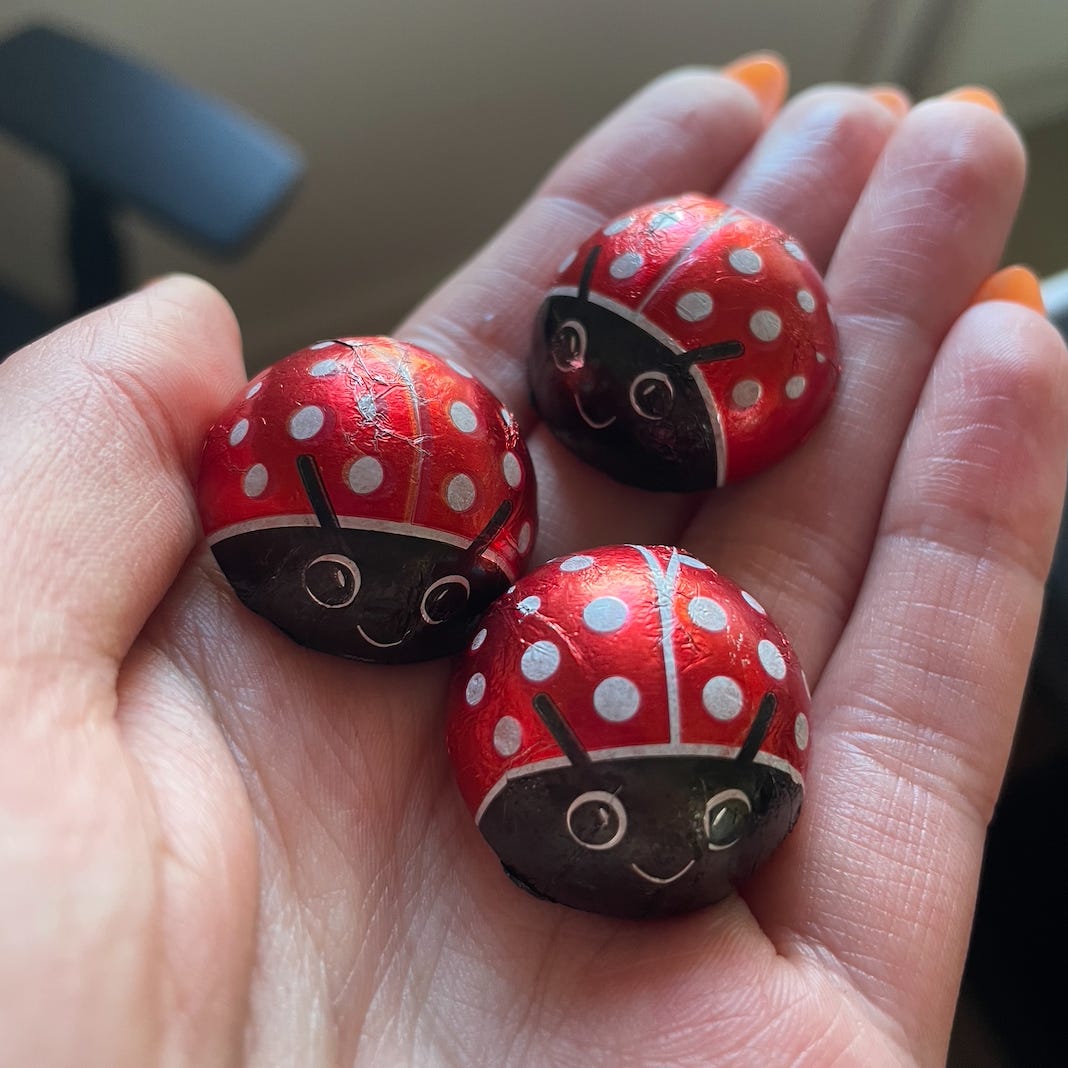
“There are bugs in my shoes,” I explained to my therapist when she asked how I was doing this week.
She nodded. On the screen. We didn’t meet in person anymore. I thought that took something away from the experience. “Can you find a feeling word for that?”
I couldn’t. I didn’t really feel I needed to. “There are bugs in my shoes,” I repeated with emphasis. Trying to help her. To slow it down, maybe condescend a little. If she was going to speak to me like a child, not a doctorate-holding adult, then I could treat her the same.
“You feel… anxious?” she proposed. “A little jittery? Like maybe the ground beneath you isn’t really stable?”
“No,” I said curtly. “I feel like there are bugs in my shoes.”
She plowed on, effort evident in her eyebrows. “Do you feel paranoid, like someone is listening? Like maybe even your shoes are bugged, so you can’t be as open and honest with me as you’d like?” She tended to pursue this line of questioning when I took our meetings at work.
I sighed. I would have to be clearer. I enunciated carefully. “There are literal fucking maggots in my slippers.”
“Oh.”
“Yeah.” I frowned.
She blinked a few times, waiting for me to say more. I didn’t.
“Were there always, um, maggots, in your slippers?” she asked.
I was offended. Why on earth would she think of me as the type of person who would intentionally acquire a breeding ground for squirmy little larvae? The mere memory of discovering the slippers in this state made my tongue want to roll out of my mouth. I had stayed out of the biological sciences for a reason: I couldn’t stomach bugs. Ironically, not a small number of people misheard me when I explained I studied etymology.
“No,” I said. “I only found them yesterday morning.”
“And what was that like?”
“It was like walking into my office, turning on my tea kettle, checking my email, and looking down to find there were fucking maggots in my shoes.”
Her eyes narrowed. “That must have been shocking.”
Finally, she was on the right track. Approximating my meaning. Sometimes I felt so far away from her, farther even, than our physical bodies, than our computers logged in to two different Wi-Fis. It often felt like I was speaking another language through a string-and-can telephone. She would sit there, nodding, taking notes, having no idea, I was certain, of anything I had said.
“It was definitely unexpected. I don’t know what they’re here, how long they’ve been here,” I lamented, like the bugs had wanted me to take it personally. Amongst many offices in the department, undoubtedly housing many other slippers, why had they chosen only my dead skin to devour? What had I done to deserve it?
“I almost put my feet in them,” I recalled with horror. “Can you imagine? If I hadn’t looked? If I’d just slipped them on?”
The therapist winced.
I blew air out of my lips, trilling them. It made me a little less nauseated.
“And how did that make you feel, finding them like that?” she asked.
I looked over at the grocery bag on the floor currently enshrouding the violated footwear. They were pink and fuzzy, a gift from my mother. Lined with little beads that held heat. You could microwave them.
“I can’t tell my mom,” I said. At least I hadn’t put them on? But still. Still, I couldn’t do it.
“Well, you can tell me,” my therapist offered, pixelated and smiling like a kindergarten teacher.
“No, I mean I can’t tell her about the bugs in my shoes. Er, the maggots in my slippers, rather,” I corrected myself. In case she didn’t think of slippers as shoes. I did. But I was trying to clarify. Sometimes she badly misunderstood me, so I had to choose the right words. As a linguist, this was a professional imperative. As an academic, I sometimes struggled. There were a lot of words to choose from, and never exactly the right audience.
“Why don’t you feel like you can tell her? Is there some tension, some friction between you two, with everything going on?” she asked.
I shook my head forcefully. “No. I can’t tell her because she gave me the slippers.” I looked over at the bag again, gagging the little motherfuckers. “I’ll have to throw them out, but I feel badly.”
My therapist’s face lit up. It did this when I used the word “feel” or something in the same semiotic family. On the screen, her face glowed, a little halo of happiness just perceptible through my MacBook’s lights. Sometimes I liked to throw the word or its relatives out there just to watch this happen. To give her something to feel useful about.
“Tell me more,” she said, tilting her head, which was all I could see of her body, in a way to suggest she was listening intently, genuinely interested in what more I had to say.
“Well, it’s just—she was so proud of herself for finding them. At Bed Bath & Beyond, I think? They really were the perfect gift. And truly, I love them. So helpful for my feet.”
“The circulation?”
“Yes, the circulation.” I thought this obvious, as I had not discussed any other kind of podiatry issue in our sixteen months of weekly therapy sessions.
“You know, poor circulation in the feet is often attributable to autoimmune diseases acquired through childhood trauma,” she said, tenting her fingertips, gazing at the camera pityingly.
“Yes, you’ve mentioned that before.” By my count, she had mentioned it at least thirty-two times. Admittedly, I almost always came to session with a large blanket over my shoulders and often complained of being cold. My office was drafty. It would be a long time before tenure, so I took these calls between sections of LING101 with my door shut in a wing that wasn’t well insulated. “I’ll get it checked out,” I lied. I was too young to go to a rheumatologist.
“Good, good. But we were discussing your mother.”
I nodded.
“Can you tell me more about why you can’t tell her about the bugs?”
I let out a long, slow sigh. I glanced at the clock. We’d already killed twenty minutes. I wasn’t sure how.
“My mom once bit into a granola bar,” I began, knowing this context was essential, “on the way to visit my—well, it’s complicated.”
“Why does it feel complicated?”
“It doesn’t feel complicated,” I corrected her. “It’s just inefficient to explain. We have a limited number of words in this language to express interpersonal relationships, and I can’t really think of a concise way to put it.”
“You don’t have to be concise here. You can take your time,” she assured me.
I knew I would have to. To slowly break it down for her, into the rudimentary blocks that would make sense at her level. As if she were an undergraduate, and not a particularly bright one. Legacy admit. Something like that.
I looked at the wall behind my laptop, drawing the relational map in my mind. Which prefixes and qualifiers could be used to explain this particular web? It wasn’t a tree, not so direct, so clear, so easy. But linked, undeniably.
“She was going to see this older gentleman we would visit all the time when I was a teenager—every Sunday, pretty much, for years. He was like a grandfather to me, though obviously, you know, not by blood.”
I checked to see that my therapist was following, She didn’t look lost yet.
“But when he started having trouble keeping up with a whole house himself (his wife had died years before, so I never met her), he moved into an old folks’ community down in Florida.”
My therapist leaned forward from her chair to interrupt me: “How did you feel about that? Having that routine broken, having this gentleman move so far away?”
I shrugged. “It doesn’t matter; it’s not important to the story.” I was getting a little irked by this point. I needed to control my temper. Have a little patience. Grace. Patience and grace. We had worked on this.
She sighed. Eyebrows knitted together with concern. “Your feelings always matter,” she said.
I continued on. “So anyway, my mom is on the flight to Florida, confined space, all the behavioral expectations of a plane, right? Bites into the granola bar. One of those really crumbly Nature Valley ones they give you on airplanes seemingly with the intention of making a mess, and, like, hundreds of nasty, tiny little bugs come crawling out of it. Into her mouth. Like something out of Alien.”
My therapist visibly shuddered. I did too. Interesting how just the sounds used to articulate a representation of that moment could render an image so powerful as to elicit an involuntary physiological reaction. This was actually the subject of an article I was working on. Different morphemes—even just some phonemes—gave swaths of people visceral disgust, manifesting as the sensation of a shiver moving up the spine. Sometimes it was mere auditory aversion, but often, these reactions were conditioned through semantic associations.
“That must have been so alarming, watching your mother bite into that.” She shuddered again.
“Well, I wasn’t there, on the trip. I didn’t actually see it. She was with her fiancé at the time. She told me later.”
Her eyebrows knitted together again. Presumably in confusion. “Your mother was engaged?”
Obviously she had been engaged. Not long before I was. I had told the therapist about this fiancé months earlier, I was sure of it.
“Yeah, good guy. The elderly gentleman was his father. I didn’t have a simple way to phrase that: ‘my mother’s former partner’s father to whom I was once close but now haven’t seen in years’? I’m sure he’s dead by now, but I don’t know. Anyway, nicest little old man. Brilliant cribbage player.”
My therapist nodded. She did look a little lost now. I was torn between triumph and a bit of guilt. I had done this somewhat on purpose. Not entirely.
“So how did you feel about losing your connection, to both of them, this grandfatherly gentleman and your mom’s ex-fiancé?”
I didn’t like that hyphenate. Ex-fiancé. My muscles tensed. There was my visceral disgust. I jotted a note on my yellow sticky pad for the article: Ex = disgusting? Looked back at the wall again. “It was hard. I miss them sometimes. But she didn’t want to marry him, and I don’t begrudge her that.”
“Mhm. It would be okay if you did.”
We sat in silence for a moment, considering that statement. I checked the clock on my screen. We’d killed enough time.
“So, anyway, the bugs.” I darted my eyes back over to the bag, to make sure it was still suffocating them. My poor pink slippers. Never again to spin around the microwave in the faculty lounge.
Evidently, my therapist had checked the clock too. “Yes, I want you to tell me more about the bugs, but just a heads-up: we’re almost at time, and I’d like to hold a few minutes for housekeeping at the end, okay?” Again, her tone reminded me of a kindergarten teacher. “I know next week will be packed for you.”
I nodded comprehendingly. “Got it, of course. Um, so the bugs.” I swallowed. My palms felt a little moist. I gripped the arms of my swivel chair.
“Mhm?” She was so encouraging, even with a non-word. Just the sound nudged me onward.
I drew a deep breath. Exhaled out my mouth, like we had worked on.
“That’s it, very good,” my laptop speakers said.
I rounded my lips, produced the fricative she was waiting for, pushed air and my tongue through my teeth. “I don’t feel like I can tell my mother about the maggots in my slippers because she will be devastated and disgusted.”
I felt my lungs start to crack a little. My hands and feet went numb, just saying it out loud. This was what people paid for, why they went to therapy, I knew. To make words, sounds, create images so powerful as to elicit involuntary physiological reactions. To let those reactions out.
I began crying. My therapist nodded encouragingly. I knew she was still monitoring our time together. She had another client after me, of course. I needed to pull myself together to make it to a department meeting.
“You know,” she said soothingly, “I think your mother will understand if you need to throw out the slippers.”
“I know, I know. Of course,” I said. “She, of all people, will understand.”
“And disgust might be uncomfortable, but it is a very natural response,” she cooed. “This is quite unsettling, what happened to you. And it might remind her of what happened to her. I think it would be perfectly normal for her to feel a little triggered. But it’s not your job to manage her reactions, right?”
I nodded in assent. Blew my nose. Dabbed at my eyes.
“It could even be an experience for you two to bond over,” she suggested.
I said nothing to that.
She shifted in her chair, cleared her throat. “Well, unfortunately, we’re at time.”
It was not that unfortunate. I could sense that we were both relieved.
“So am I seeing you next week?” she asked, shuffling through her calendar. “Or would you prefer to reschedule? It could be helpful to check in, maybe work through anything that might be coming up? But I know you’ll be very busy.” Her face lit up like it would when I used “feeling” words.
“Oh no,” I said, sorry to extinguish her glow. “I canceled that.”
Her face fell, almost audibly. “The wedding?”
Obviously the wedding. Why else would I have used a demonstrative pronoun without a referent? I wondered whether she listened to me at all.
“So I’ll be free next week,” I said.
She didn’t do a great job hiding her shock. It came across the screen rather glaringly.
“Cold feet?” she asked, aghast.
There were fucking maggots in my slippers, so yes, obviously. But that had nothing to do with the decision to cancel my wedding.
I knew that in her field they called this a “doorknob confession.” In therapist-speak, the expression referred to when a client waited until the end of a 50-minute session to drop an emotional bomb. Something that should have been discussed earlier but would have to wait until a later date to be unpacked.
But I wasn’t doing that. I had tried to tell her all session. I think I’d been trying to tell her for weeks, but she just wasn’t hearing me. Besides, there was no doorknob to reach for. I wasn’t walking out of her office, saying this flippantly over my shoulder. I was clicking Leave Meeting.